
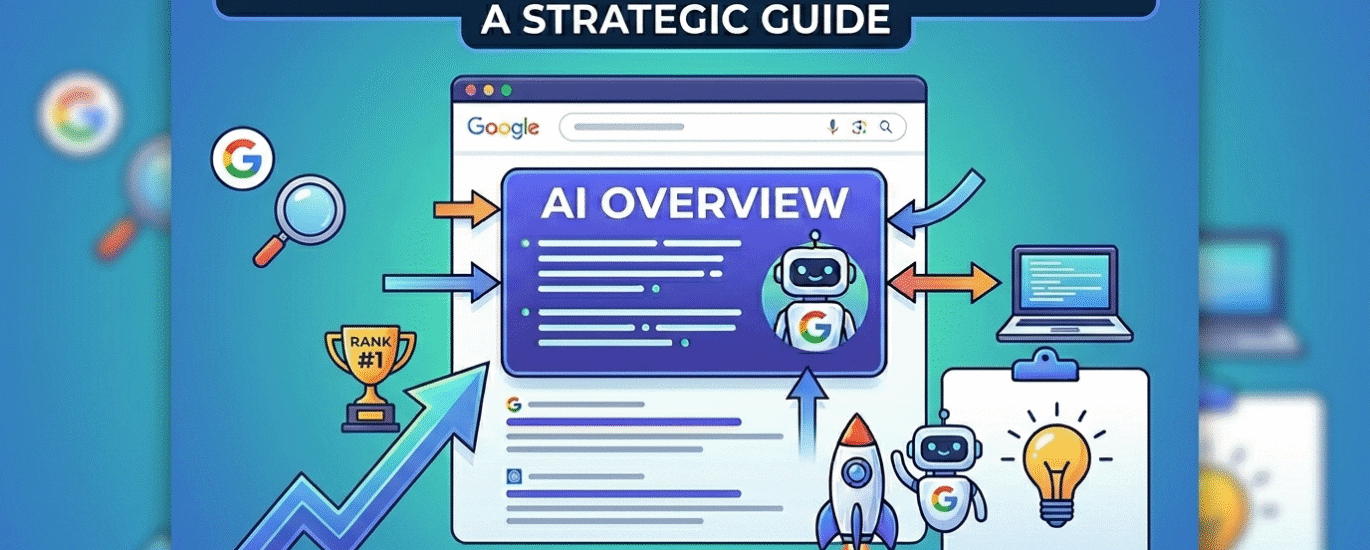
Search results are not what they used to be a few years back. Google is no longer just showing links.
It is answering queries directly through AI Overview, pulling insights from multiple websites and presenting them in one place.
That shift changes how visibility works. Ranking is no longer enough. Being selected as a source is what matters now.
How to Rank in AI Overviews of Google in 2026?
To rank a website in Google AI Overview, focus on giving clear answers at the start, structure your content for easy extraction, cover the full topic instead of a single keyword, and build trust through real insights.
Google prefers content that is easy to understand, well-organized, and backed with depth.
Traditional SEO alone is not enough anymore. Keyword placement and backlinks still matter, but they are not the deciding factor.
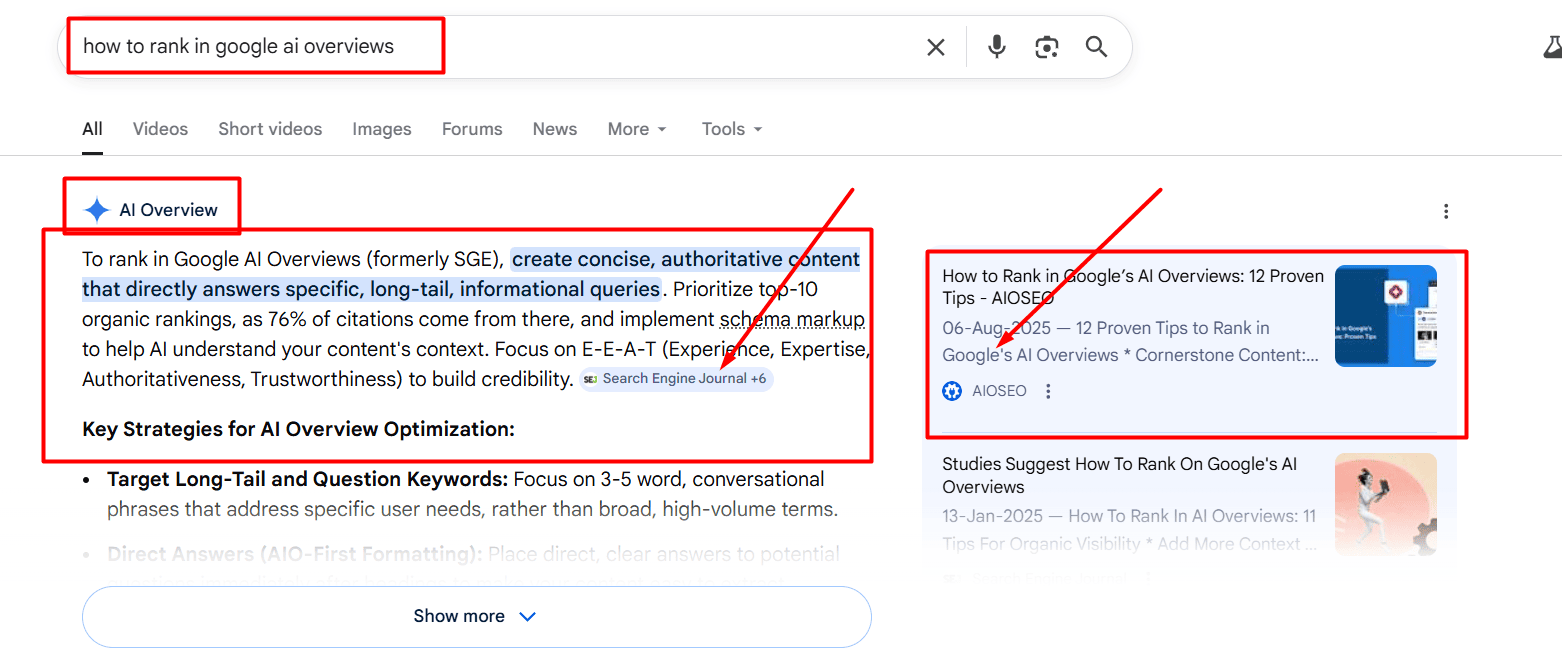
AI systems evaluate clarity, usefulness, and how well your content answers variations of a query. If your page is not built for that, it will be ignored even if it ranks.
What is AI Overview (Google AI Overview Explained Simply)
AI Overview is Google’s AI-generated answer that appears at the top of search results.
It summarizes information from multiple sources and gives users a complete response without needing to open multiple links.
For example, if someone searches “how to get rank in AI overview,” Google may show a summary explaining steps, strategies, and best practices, all combined from different websites.
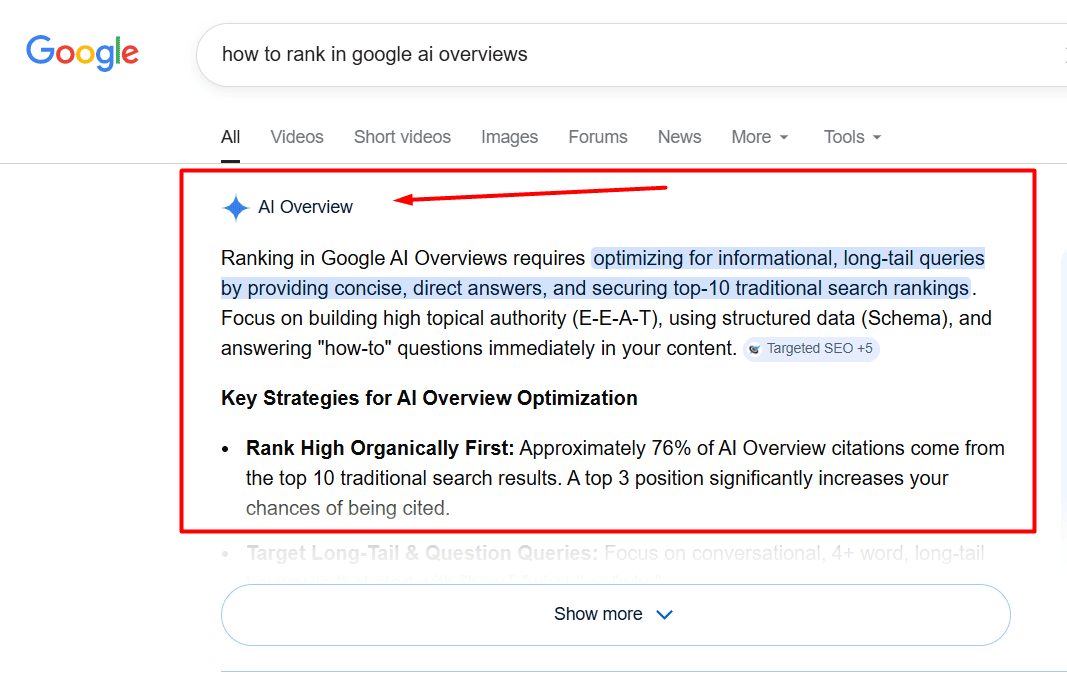
Your content can be one of those sources if it is strong enough.
Where AI Overview appears in search results
AI Overview usually appears above traditional organic listings. It takes the most visible position on the page, often pushing normal rankings further down.
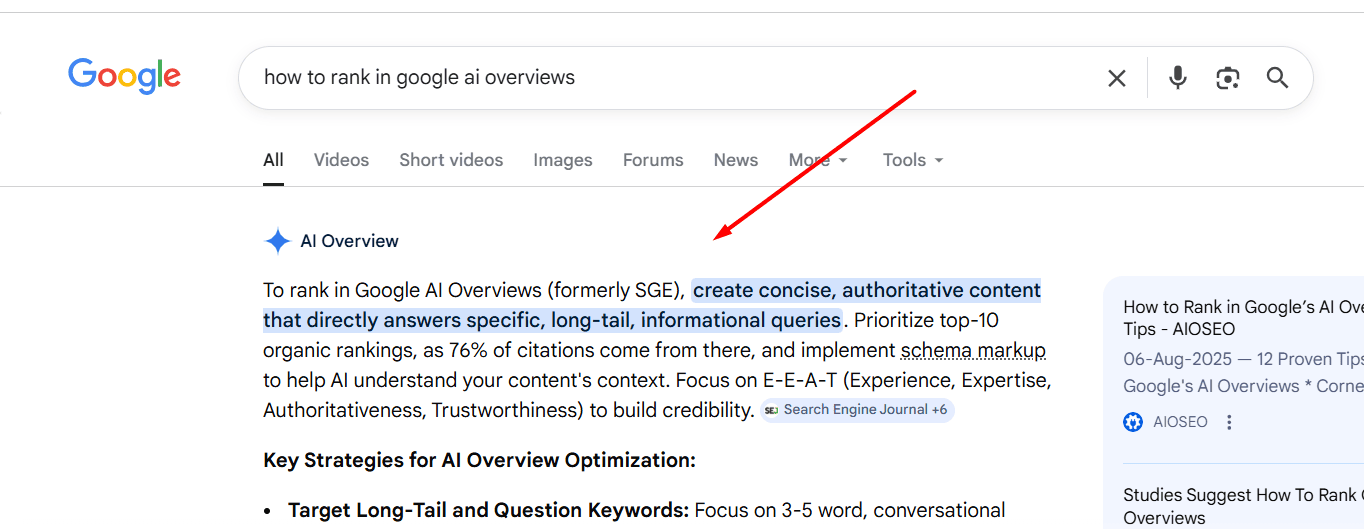
On some queries, it sits above featured snippets and ads, making it the first thing users see.
Difference between featured snippets vs AI overview
| Feature | Featured Snippet | AI Overview |
| Source | Single page | Multiple pages |
| Format | Short answer | Detailed summary |
| Control | Easier to target | Harder to predict |
| Depth | Limited | Multi-layered |
Featured snippets rely on one clear answer from a page.
AI Overview combines information from multiple sources, which makes it harder to control but more powerful in reach.
Why AI Overview reduces clicks but increases visibility
AI Overview answers the query directly, so many users do not click further. That reduces traffic for some queries.
At the same time, visibility increases because your content can appear inside the AI summary even if you are not ranking number one. Users still see your brand, your insight, and sometimes your link.
This creates a shift. Traffic may drop, but authority and exposure can grow if you are consistently cited.
How Does Google AI Overview Work (Behind the Scenes)
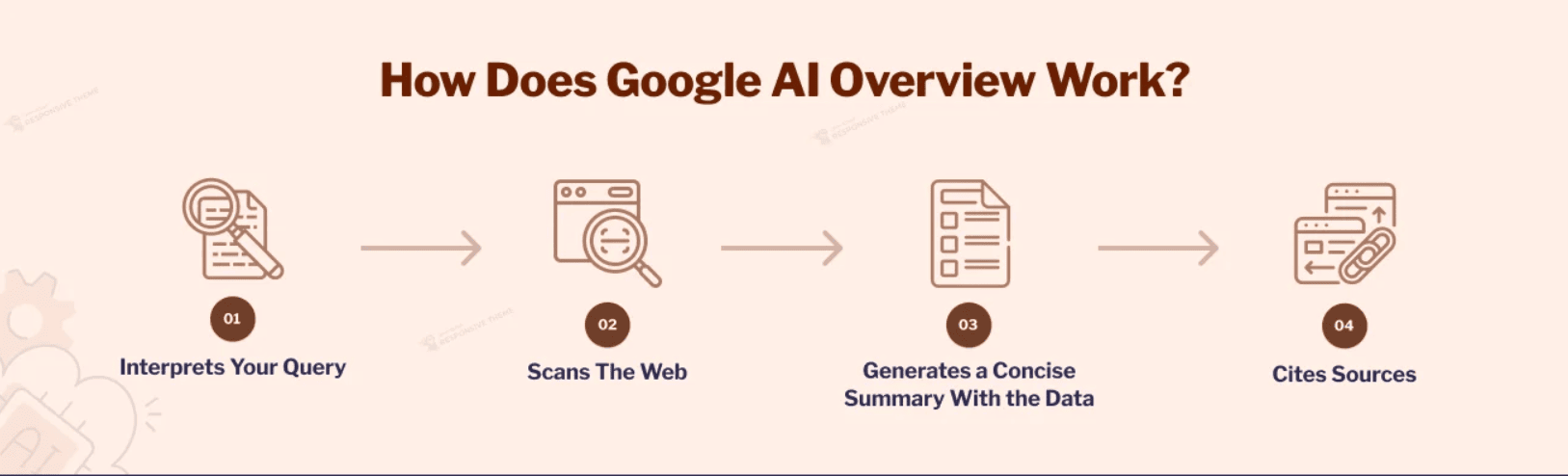
Let’s see how Google generates AI answers from multiple sources.
How Google generates AI answers from multiple sources
Google uses large language models to understand the query and gather relevant information from different pages.
It does not just copy content. It interprets, combines, and rewrites it into a structured answer.
The system looks for:
- Clear explanations
- Well-structured sections
- Content that directly answers the query
- Reliable sources with authority
Why it pulls content from multiple pages, not just one
No single page covers everything perfectly.
AI Overview is designed to create a complete answer. That is why it selects different parts from multiple sources.
One page may define the concept. Another may explain the process. A third may provide examples. Google combines all of them into one response.
This means you do not need to dominate everything. You need to be the best at a specific part of the answer.
Role of page-one rankings in AI overview selection
Most sources cited in AI Overview still come from page one results. Ranking matters because it signals trust and relevance.
However, being on page one does not guarantee inclusion.
Many top-ranking pages never appear in AI Overview because their content is not structured or clear enough for extraction.
Query expansion and how AI searches beyond one keyword
AI does not rely on a single keyword. It expands the query into multiple related questions.
For example:
“how to rank in AI overview” may expand into:
- what is AI overview
- how google selects sources
- AI seo strategies
- content optimization for AI search
If your content only targets one keyword, you miss the bigger picture. AI prefers pages that answer multiple connected questions naturally.
How to Rank in AI Overview of Google (Core Principles That Actually Work)
Here are the core principles you need to follow to get noticed in AI Overview.
Answer First, Then Expand (Most Important Rule)
Start every important section with a direct answer. Keep it short and clear. Two to three lines are enough.
After that, expand the topic with details, examples, and explanations.
If you delay the answer or hide it deep inside the content, AI will skip your page.
Real-world testing shows a simple truth:
“Answer first… otherwise it gets skipped”
Match Search Intent Better Than Everyone Else
Search intent is not just about keywords. It is about what the user actually wants.
Types of intent:
- Informational: learning something
- Commercial: comparing options
- Mixed: learning before taking action
AI prefers content that clearly matches intent. If someone wants a guide, give a structured guide. If they want comparison, provide side-by-side insights.
Confused intent leads to weak selection.
Build Topical Authority Instead of Single Keyword Pages
Focusing on one keyword is outdated. AI looks at how deeply you cover a topic.
Instead of writing one page on “AI overview,” create content that covers:
- definition
- working process
- ranking strategies
- examples
- common mistakes
This creates topical authority.
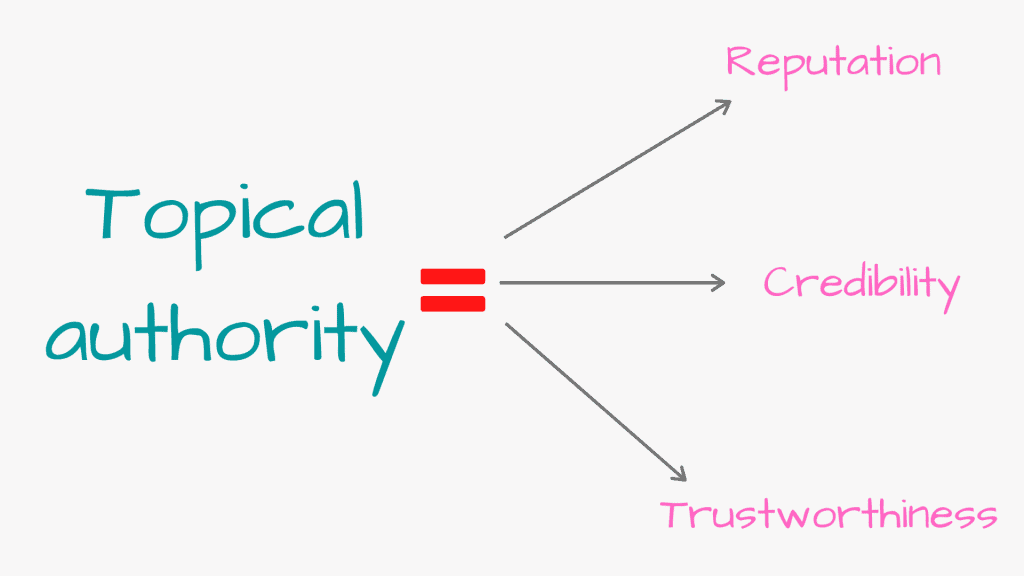
Insight that matters:
AI pulls from topic depth, not keyword density. Repeating a keyword does nothing if the content lacks depth.
Structure Content for AI Extraction
AI systems prefer content that is easy to scan and understand.
Use:
- Clear H2 and H3 headings
- Bullet points for breakdowns
- Tables for comparisons
- Short paragraphs for readability
Avoid long blocks of text. They reduce clarity and make extraction harder.
Well-structured content increases the chances of being picked.
Add Real Experience and Examples (E-E-A-T Boost)
Generic content does not stand out anymore. AI prefers signals of real experience.
Include:
- Practical insights
- Case examples
- Observations from real work
- Pros and cons
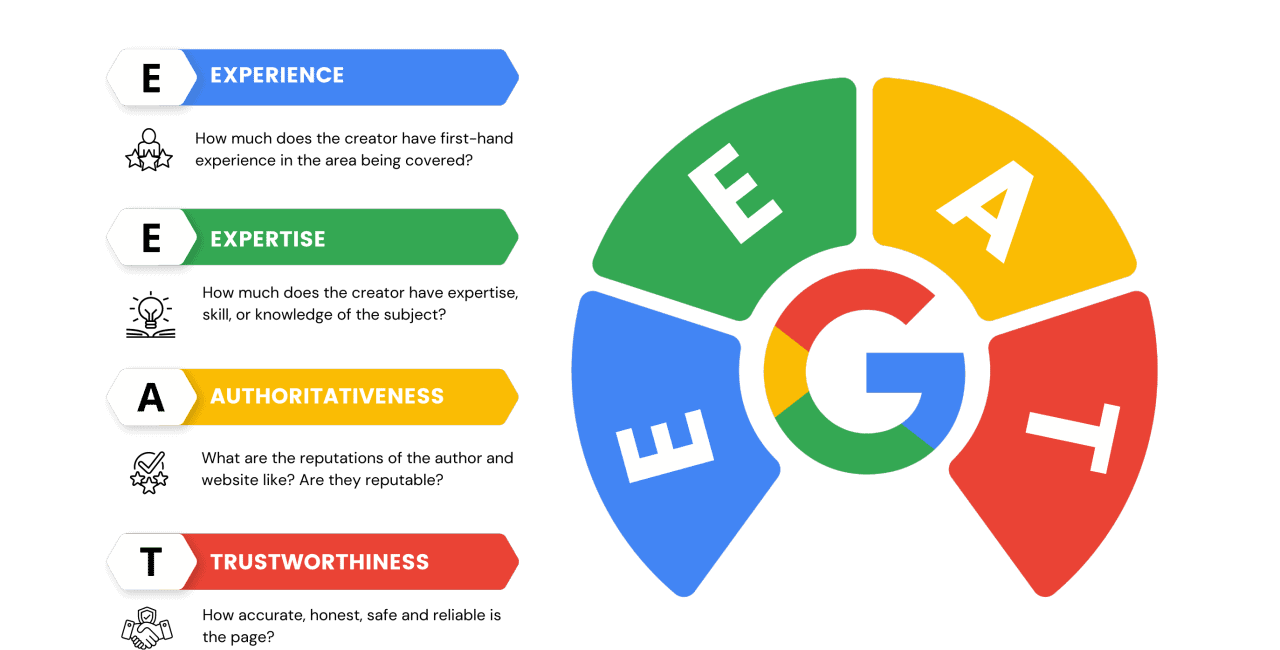
This builds trust and increases the chances of selection.
Content that sounds like everyone else gets ignored.
Optimize for Entity and Semantic SEO
AI understands topics through entities, not just keywords.
Entities include:
- Tools
- Platforms
- Brands
- Concepts
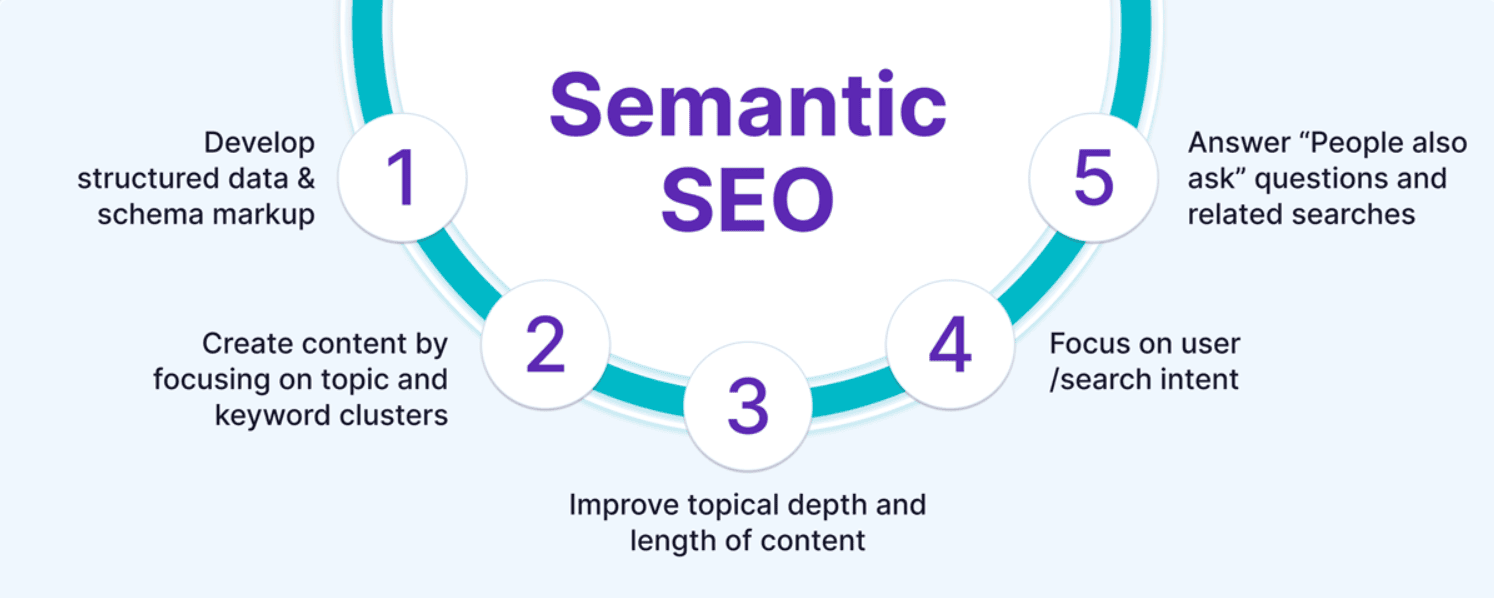
When writing about AI Overview, naturally include related terms like search systems, ranking signals, structured content, and user intent.
Cover related subtopics without forcing keywords. That creates semantic richness.
Keep Content Updated and Fresh
Freshness matters more than before. AI systems prefer updated and relevant information.
Old content loses visibility over time.
Simple strategy:
- Update statistics
- Improve explanations
- Add new sections
- Refresh examples
Updating existing content is often more effective than creating new pages.
How to Optimize Content for AI Search (Step-by-Step Framework)
Let’s break down each step to make your website and content AI-ready.
Step 1 – Start With Question-Based Keywords
Most people still chase plain keywords. That approach misses how AI reads intent. Queries today are shaped like conversations, not fragments.
Think in questions, not just terms.
Instead of forcing “AI overview ranking,” shift toward angles like:
how to rank websites in AI overview, why pages get selected, what google looks for, best practices, vs comparisons.
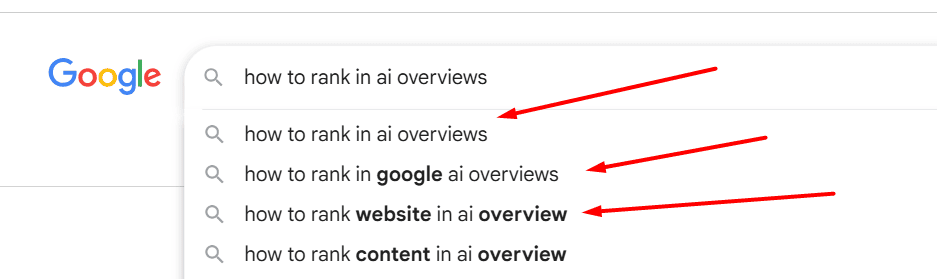
This does two things. It aligns with real user thinking, and it gives your content multiple entry points into AI systems. One page can answer ten variations without feeling stretched.
A simple way to build this layer is to list 10–15 questions around your topic before writing anything. That becomes your natural flow, not forced SEO.
Step 2 – Create “Answer Blocks” Inside Content
AI does not read like a human scrolling slowly. It scans, extracts, and moves on. If your answer is buried, it is invisible.
Each section should open with a tight response. Something that can stand alone if lifted out of context.
For example, instead of slowly building toward the answer, drop it early, then explain it. This makes your content quotable. AI systems prefer chunks that can be reused without rewriting everything.
A good test is simple.
If someone copies just 2–3 lines from your section, does it still make sense on its own? If yes, you are doing it right.
Step 3 – Expand With Depth (Multi-Angle Coverage)
Short answers get picked, but shallow content does not last. Depth is what keeps your page relevant across different queries.
Instead of stretching one explanation, approach the topic from different sides.
Show how it works, where it fails, when to use it, and how it compares to alternatives.
Comparisons naturally widen your reach. Use cases make your content practical. FAQs capture hidden queries that people do not type exactly but still expect answers for.
This is where most content falls apart. It explains one angle well but ignores everything around it. AI prefers pages that feel complete, not partial.
Step 4 – Add Structured Data (Schema That Helps AI Understand)
Structure is not just visual. There is also a technical layer that helps machines interpret your content faster.
Schema acts like a translator between your page and search systems. It tells Google what each section represents instead of leaving it to guess.
FAQ schema highlights direct answers. The article schema defines the overall content. The author schema adds credibility signals.
You do not need to overcomplicate this. Even basic implementation can improve how your content is processed. Think of it as giving your page labels so AI does not have to figure everything out from scratch.
Step 5 – Improve UX Signals (Still Matters)
Even with AI-driven search, user experience is not optional. If your page is slow, cluttered, or hard to read, it weakens everything else.
Speed plays a silent role. A slow page gets abandoned quickly. Mobile experience matters even more because most users are not on desktop.
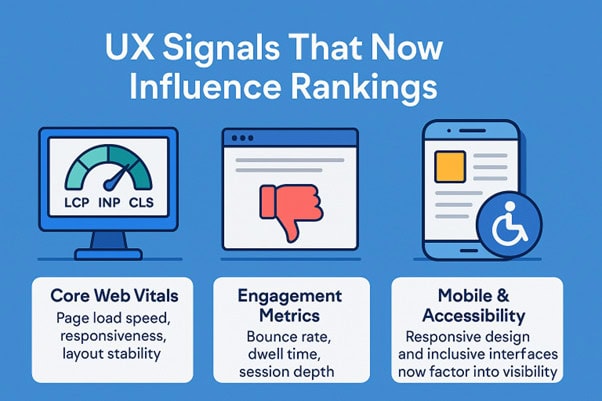
Design should not distract. Clean spacing, readable fonts, and logical flow make a difference. When someone lands on your page, they should not struggle to find the answer.
Good UX does not guarantee selection, but poor UX quietly removes you from the race.
Why Some Pages Rank But Don’t Appear in AI Overview
You will see pages sitting at the top of search results but missing from AI Overview. That confuses many people.
Ranking and citation are not the same thing anymore.
A page might rank because of backlinks or authority, yet still fail to appear in AI results. The reason is simple. It does not fit the extraction model.
Sometimes the issue is subtle. The content answers the question, but not in a clean or direct way. Other times, it focuses too narrowly on one keyword while AI is pulling from broader variations.
Another common gap is structure. Long paragraphs, vague headings, and delayed answers make it harder for AI to pick usable segments.
Key reality:
AI Overview ≠ traditional ranking system
AI Overview Ranking Factors (Based on Data, Not Guesswork)
There is no single factor that guarantees inclusion. It is a combination of signals working together.
Authority still matters, but it is not enough on its own. Trust signals, author credibility, and overall site quality influence selection.
Relevance is sharper now. Not just matching keywords, but matching the exact intent behind the query. If your answer feels slightly off, it gets skipped.
Structure plays a bigger role than before. Content that is easy to scan, break down, and extract has a clear advantage.
Semantic completeness is another layer. Covering related ideas, not just the main topic, increases your chances of being used across different queries.
Entities help connect your content with known concepts. Freshness keeps it relevant over time.
AI prefers extractable expertise, not just rankings.
Types of Content That Get Featured in AI Overview
Not every format performs equally. Some types naturally fit how AI builds answers.
Guides work well because they explain topics step by step. They provide both clarity and depth.
Comparison content gets picked when users are deciding between options. It offers structured differences, which AI can easily summarize.
How-to tutorials are strong candidates. They break down actions into clear steps, making them easy to extract and present.
Definitions and explanations often appear in AI Overview because they answer foundational queries directly.
If your content falls into these formats, your chances improve without extra effort.
Common Mistakes That Kill AI Overview Chances
Many pages fail not because they lack information, but because they present it poorly.
Long introductions are one of the biggest problems. Users want answers quickly, and AI follows the same pattern.
Keyword stuffing still exists, and it still does not work. It makes content feel unnatural and adds no real value.
Thin content is another issue. Covering a topic lightly might help you publish faster, but it weakens your authority.
Lack of structure makes even good content unusable. If AI cannot break it into meaningful parts, it moves on.
The biggest mistake is having no real insight. Rewriting what already exists does not give your page a reason to be selected.
Advanced Strategy to Get Cited More Frequently in AI Overviews
Optimize for “Query Fan-Out”
One query rarely stays as one query. AI expands it into multiple related searches behind the scenes.
If your content only answers the main question, it limits its reach. But if it naturally includes related angles, it becomes useful across a wider range.
Think of it like covering a cluster without forcing it. Each section answers a slightly different variation, and together they build a stronger presence.
Use Multi-Format Content
Not everything should be written in paragraphs.
Some ideas are clearer in lists. Others need tables. Certain explanations work better with simple breakdowns.
Mixing formats makes your content easier to process. It also increases the chances of different parts being picked.
A comparison table might get extracted for one query, while a short explanation gets used for another.
Build Brand Mentions Across Web
AI does not rely only on your website. It looks at how your brand appears across the web.
Mentions in forums, blogs, and social platforms act as supporting signals. They create a sense of presence and credibility.
This does not mean spam. It means being visible in relevant discussions and contributing useful insights.
Over time, this builds recognition. When AI systems see your brand repeatedly associated with a topic, trust increases.
AI Overview vs Traditional SEO (What Changed)
| Factor | Traditional SEO | AI Overview SEO |
| Focus | Keywords | Topics |
| Ranking | Position-based | Citation-based |
| Content | Optimized | Extractable |
| Strategy | Rank pages | Be referenced |
The shift is clear. It is no longer about holding a position. It is about being part of the answer.
Future of SEO with AI Overviews
Search behavior is moving toward instant answers. Users expect clarity without effort.
Clicks may decline for some queries, especially informational ones. But visibility is not disappearing. It is changing form.
Being cited inside AI responses becomes more valuable than simply ranking on a page.
This changes how success is measured. Instead of only tracking traffic, focus shifts toward presence, authority, and consistency.
Final Verdict to Ranking Content in AI Overviews:
AI SEO is not a separate system. It is the next stage of how search works.
Clear answers, strong structure, and real depth are no longer optional. They are the baseline.
The approach is simple but not easy.
Write in a way people understand instantly. Organize it so machines can use it without confusion.
The final takeaway stays straightforward.
Write for humans, structure for AI.
Frequently Asked Questions
What are the main ranking factors for AI Overview?
Website Authority, Topical Authority, relevance, structured content, semantic coverage, entity usage, and freshness all play a role in selection.
Why is my site not appearing in AI Overview?
Common reasons include weak structure, unclear answers, lack of topical depth, or content that does not match expanded query intent.
How do I know if my content is optimized for AI search?
If your content gives direct answers, is easy to scan, and covers multiple related questions, you are on the right track.
Is ranking #1 required to appear in AI Overview?
No. Many pages in AI Overview are not in the top position. What matters more is how useful and extractable your content is.
If my website is new, can I still appear in AI Overview?
Yes. A new site can get picked if the content is strong, clear, and actually answers the query better than others.
How important is content structure for AI Overview ranking?
Very important. Well-organized content with headings, short paragraphs, and clear sections increases the chances of being selected.
Does AI Overview replace traditional SEO?
Not completely. Traditional SEO still matters, but AI Overview focuses more on content clarity, structure, and topic depth rather than just rankings.

Zaid Salfi, CEO of Brandifys and author with 10 years of digital marketing experience, shares expert insights on business growth and marketing strategies.


